

Sometimes, instructions for relatively simple and straightforward tasks can become weirdly difficult to give. Let’s take an example. Most of us are familiar with running dictations (if you don’t know what they are, you definitely should—have a look here!) It’s a great warmer / lead-in, and a very simple activity that requires minimal preparation and can be done almost everywhere. However, I’m ready to bet that, when in the classroom, having to explain the activity to the students, more than one of us will have found that the process of giving instructions for this relatively simple task can run into a lot of unexpected hiccups. Students who don’t understand who they’re working with; Students who think they have to memorise the entire text in one go; students who are sitting suddenly standing up to “check their answers”—the list could go on and on. And I’m sure that the question popping into our head when this happens is why? Why is it that an activity with so few steps can be so difficult to explain?
In today’s post, we’re going to deal with just that. We’re going to be looking at some theory behind giving and processing instructions, and – as usual – some hands-on practical tips that can make our teaching life a bit easier. Let’s jump right into it.
Our brain RAM: Cognitive Load Theory
A theoretical framework that is extremely insightful when dealing with issues of instruction and comprehension is Cognitive Load Theory (CLT). Introduced by the educational psychologist John Sweller in the 1980s, CLT deals with cognitive load, i.e. the amount of real-time information that our brains can process at one time (before cognitive scientists jump down my throat, I know it’s an overgeneralisation! You can find more information on CLT here, and by reading Sweller’s work). The core idea is the presence of three types of cognitive load, and here I quote:
- Intrinsic cognitive load: How easy or difficult the content presented inherently is to learn, which stays relatively constant.
- Extraneous cognitive load: How easy or difficult it is to learn the content considering the environment in which it is presented, which varies.
- Germane cognitive load: The mental resources required to fit the material into schemas, our cognitive frameworks for organising and interpreting information. (Adapted from this)
Let’s put this in context by looking back at our running dictation.
Here, The intrinsic cognitive load of this activity is not high: one person runs, the other person writes, and the first team to have the full message wins. However, the extraneous cognitive load can make or break a successful activity setup, and it’s here that the devil lies: there are a number of complexities in the details of the activity that can create confusion, e.g. can the runner go back and forth? Can the runner scream the message from a distance? etc. Even just explaining who should sit and who shouldn’t can create problems if not explained properly. That might affect the germane cognitive load, i.e. whether the message gets across, and, ultimately, the success of the activity. In TEFL especially, where timing is key, poor instructions can be the death of an otherwise successful activity, and when I say this I know that most of the readers will be nodding quietly—we’ve all been there.
Below are some theory-backed and gruelling-classroom-experience-tested methods that can minimise extraneous cognitive load and make everyone’s life much easier.
Task Segmentation (breaking tasks in smaller steps):
Remember when you did prime factorisation in school —what’s the prime factorisation of 12? 2 x 2 x 3. Now, think the same, but with tasks: what are the “prime factors”, i.e. the most basic steps you can think of for a task? Let’s take our running dictation again. Students work in pairs. There are two types of students, A and B, or runners and writers, you choose.
A needs to do the following minimal steps:
- Stand up
- Run to the text
- memorise the text
- Run back
- Tell chunks of the text to their partner
B needs to do the following minimal steps:
- Get something to write (a pen) and something to write on (a notebook, a sheet, an ipad etc.)
- Wait for A
- Write what B tells them
Those are the core steps of the activity. Now we want to think of any other parameters that are included in the activity and that might create confusion. I find that using a set of basic questions, like the below, can help us identify these parameters quickly. Note that the answers in brackets are based on how I do my running dictations —yours might be different!
- What? (Transcribe as much as possible, as accurately as possible, within the time limit)
- How? (In pairs, as a team, steps above)
- When? (When I say start, everybody at the same time)
- How long? (3 minutes)
- Limitations? (A can’t scream from a distance, A can’t take photos, B can never stand up and go check)
Let’s break down exactly what each question means:
- What? Describes the goals of the activity in the clearest way possible.
- How? Describes the steps (see above) and the student-student / student-teacher dynamics (alone, in groups, in pairs, competitive or cooperative etc.)
- When? Describes the progression of steps and, in the case of group activities, whether the steps are followed sequentially or at the same time
- How long? Describes the time limit. Is it strict or is it flexible? Is it explicit (the students know about it) or is it teacher-managed?
- Limitations? Describes things that cannot be done or can only be done in a certain way for the activity to work.
It goes without saying that this is just a framework that works for me. If you start using it, you’ll certainly develop your own, one that works best for you. It’s a starting point on our journey towards less painful instruction-giving.
Visualising tasks
We’ve mostly focused on verbal instructions so far. However, the visual component is clearly as important. This is especially important in light of a common issue in many textbooks these days. For editing reasons (I assume?), a number of tasks are visually condensed in one “bullet point” or “activity” and this can create problems. Take a look at ex. 4 here (source: NGL Voices Upper Intermediate).

Instructions to this activity can be quite overwhelming since, despite being presented as a single task, it’s actually a number of tasks in one. If you try to give the instructions and treat them as one task only, you can rest assured your students will experience in first person the effect of cognitive overload.
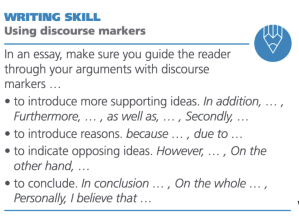
The Writing Skill box referenced in activity 4.
How can we make this easier for learners and less stressful for us? Let’s take it one step at a time – no pun intended (maybe).
First, we can use the question framework above to divide it into steps. The main question here is the “what?” – basically, the learning goals. How many goals does this activity have? If there is more than one learning goal, then this “activity” is actually more than one task condensed into one. So, if we look at 4 we have:
- Read (and understand) the Writing skill box.
- Find all the discourse markers in the essay [not shown here]
- Match each discourse marker with one of the categories in the box.
Since the three learning goals are undoubtedly related (the idea is for learners to identify the target language), we can define these as “sub-goals” in the framework of activity 4. The issue here is that these three sub-goals are packed in one, visually crowded activity. This is a textbook example (I swear I don’t pun on purpose) of how poor visual design can lead to extraneous cognitive overload, making an otherwise straightforward activity quite cumbersome.
If you’re asking yourself – How do we fix this?, the great news is that we already have. The easiest and by far most efficient way to do it is to do exactly what we did above.
Divide the main tasks in three subtasks, which I have named a, b, and c but you can call whatever you want. Then, use bullet points setting the three sub-aims / steps. In the case of 4, that would mean something along the lines of:
4
- Read the writing skill box. (Check with a partner that you understand what discourse markers are).
- Underline all the discourse markers you can find in the essay.
- Match each of them with one of the categories in the Writing skills box.
You might have noticed that I’ve added an extra step in brackets in a: this is because I think that reading the box is not necessarily straightforward, and a minimal comprehension check could help.
These strategies are just two tips that can help us break down complex instructions. No matter how you do it, however, it’s the focus on minimal steps that really is crucial. Breaking instructions into smaller steps makes them less overwhelming and it helps students focus by giving them one clear step at a time. It also reduces the effort needed just to understand the task, which in turns leaves more mental space for actually doing the task. And when it comes to classroom management, it makes the lesson flow more smoothly and it makes it easier to monitor progress and spot problems. It helps learners manage their processing load, and ultimately makes progress more achievable by giving scaffolding and structure. And if it makes life that bit easier for us teachers, that’s all the better!
 The Teaching Tapestry TEFL
Leave a comment