The Teaching Tapestry TEFL

TEFL, Ideas, and Innovation in action

  • Sometimes lesson openers fall flat, leaving students passive and disengaged. By blending engaging warm-up activities with traditional lead-ins, we can motivate learners and lower their barriers to learning. In this article we discuss how.

    Many lessons start with words. We’re all familiar with lead-in questions, quotes,  opening statements, and so on. More recently, a number of popular books that utilize the lexical approach often include vocabulary activities as the first activity in the unit. The one thing I have always found ineffective when it comes to these types of lead-ins is the fact that they are quite passive, so to speak. Students often have to look at the board or read some questions on the book,  placing them in a situation where they are at the receiving end of the language and not actively engaged with it—the effort to focus on these language chunks is on their end. 

    What this does is adding a degree of unpredictability to the effectiveness of these lead-ins.  Arguably, the two main purposes of lead-in activities are to turn down the so-called affective filter and to activate learners’ schemata. In simple terms, this means having students engage with the content of the lesson and getting them interested. However,  anyone who has taught a low motivation class will definitely be familiar with the lack of engagement that many students might bring into the classroom. For a number of different reasons, which we will not go into in this article, it might be extremely difficult for students to just “ flip”  that switch and suddenly become engaged and interested. With this in mind, how can we change this model and make students active participants in their relationship with the text? 

    Interestingly enough, a number of warm up activities which are often used at the beginning of a class to “ wake up”  students and increase their motivation can be combined with lead in tasks themselves,  so that students are engaging with the content of these tasks while focusing on the more ludic aspect of these warmers. 

    As far as I know,  there is no scientific classification of warm-up activities in language classrooms.  This will actually be the focus of a future article,  so stay tuned for that. Today, however,  I want to focus specifically on the category I call text-focused warmers. In these warmers,  learners engage with words, phrases, sentences or different types of language chunks. The goal is usually to copy, dictate, or report strings of text in a fun and engaging way.  some activities are static, i.e. all participants stay still, whereas other activities are dynamic, i.e. one or more participants need to move as part of the warm-up activity itself. Regardless, these warmers require cooperation within pairs and teams in order for the target language to be relayed successfully. Some examples of these activities are running dictations, back-to-back dictations, back to the board (in all of its variants), and Chinese whispers. I’m sure many of you will already have guessed where I’m going with this. 

    The trick here is to use these warmers as a way of presenting the language that’s contained in the lead-in tasks. This way, rather than an extra activity in of itself, the warmer can be used to present questions or texts in an engaging way. Learners will be forced, so to speak, to focus on the language being presented, as well as its pronunciation and spelling, with an extra focus on accuracy. As a result, students will therefore be already engaged with the text. Much of their energy and attention will have been devoted to “winning” the game,  and the communicative purpose of the activity will in fact be to be successful at the task itself as opposed to complying with top-down instructions given by the textbook and/or the teacher. In other words, students will be so focused on winning the game that they will put in extra effort into their reading, grammatical accuracy, pronunciation, listening and spelling skills without even knowing it.  By the end of the activity,  their affective filter will have been turned down and their schemata — the scaffolding our brain utilizes to acquire new knowledge — will have been activated without explicit instructions to do so. There’ll be engaged, active, and already focused on the lesson topic—exactly what a lead in activity is supposed to achieve. 

    This works particularly well with so-called lexical approach “noticing” activities. These activities are quite popular in books that adopt the lexical approach, such as NGL’s Outcomes series. In these activities learners are presented with a number of lexical items and are asked to complete meaningful sentences that use these lexical items as soon as they jump into the lesson.  While this is great for guided discovery, mediation and negotiation, it can feel quite overwhelming since it often happens at the very beginning of the class and students are often presented with a large number of lexical items they are not familiar with. This is why having learners relay these items as part of one of these text-focused warmers means that they will focus on the fun aspect of the activity while at the same time doing their best to identify and categorize these new lexical items— not just on their own but in a mediated effort with their partner or partners.  Once these words are presented, we can often add an extra stage where learners are asked to discuss their meaning, form and pronunciation before they even open their books. The result of this is that once students finally move on to the actual gap fill activity they will have already acquired familiarity with the target language. This will not just make the activity less overwhelming,  but it will encourage and facilitate active retention and acquisition of the lexical items— which, is worth remembering, is in the end the ultimate goal of learning. 

    As an added bonus, using warmers this way will also ensure that students have a written record of the target language on their notebooks or tablets. This will in turn encourage them to be more creative with how they go about using these items. Printed textbooks often provide only limited space for “playing around”  with new words, whereas having these words or phrases on your own device— be it pen-and-paper or digital— creates an extremely learner-centred environment where students are free to explore and manipulate the target language in whichever way suits them best. Once again, the focus here is maximizing engagement and schemat activation in order to promote active retention as opposed to what can feel like a textbook activity—“doing the book”.

    Let’s now look at an example of how this can be done. Let’s consider a very typical lead in activity—questions introducing the topic for the lesson. Take the example below.

    (Speakout Intermediate 2nd Edition unit 1.1 page 8)  

    This activity has a twofold goal. The first goal is to introduce the topic of language learning by discussing the questions. The second goal is to consolidate and/or acquire new vocabulary connected to the class topic. With this in mind, there are a number of ways we can go about doing this.

    1. We can focus on the target language (words in bold). Here’s a list of quick steps that can be followed to set up a running dictation for an active presentation of this target language:
    1. Copy the words in a text file. You can do this manually, or take a screenshot and use AI to do it, which saves precious time.
    2. Print out the file. A few minutes before class, hang it outside the door or leave it on a windowsill. Always keep an eye out for health and safety – you don’t want anyone to get hurt!
    3. Explain to the students the rules for a running dictation. You can play around with the details, but the core idea is that one student will sit and write down the words, and another student will run to the printout and relay the words to their partner. 
    4. Set a timer for the activity and have students do it.
    5. When the time is up, display the words on the board. Ask students to work in pairs and discuss the meaning and pronunciation of the words. If you want to put extra focus on the language aspect, you can also ask to identify the word class (adjective, noun, etc.) and write down the base form of the word (e.g. singular for nouns, infinitive for verbs etc).
    6. Discuss in plenary.
    7. At this stage, ask students to open their book and discuss the questions in ex. 1. 

    This is only one possible example of how these warmers can turn an otherwise potentially overwhelming activity into a fun one, shifting the focus of the task, turning down the affective filter, and therefore promoting learning.


    Based on your setting, you might want to pick and choose the most appropriate activities. In some setting, kinaesthetics might be hard to implement or frowned upon. In that case, you can opt for a more standard dictation, where a student comes to the board and reads out words, or where students work in pairs and read the words to one another. There is potentially no limit to the type of variations and adjustments you can make to these warmers, so don’t be afraid to change things in a way that works for you. In teaching, no one group and no one setting is the same—it’s the blessing and the curse of our job. 

    Let’s recap what we discussed in the article:

    • Standard lead-ins are often passive and fail to engage students.
    • Text-focused warmers (e.g. running dictations, back-to-the-board) can double as lead-ins, making learners active and lowering the affective filter.
    • These activities promote focus on meaning, pronunciation, and accuracy while keeping motivation high.
    • Integrating warmers with lexical noticing tasks makes new vocabulary less overwhelming and supports retention.
    • Don’t be afraid to adapt and be creative with these activities, adapting them to your context and your learners’ needs.

    I look forward to hearing your ideas on this topic. Do you already do this? What activities are the most successful when presenting a lead-in? 
  • Don’t Overload Them! Tips for Minimal Step Instructions

    Sometimes, instructions for relatively simple and straightforward tasks can become weirdly difficult to give. Let’s take an example. Most of us are familiar with running dictations (if you don’t know what they are, you definitely should—have a look here!) It’s a great warmer / lead-in, and a very simple activity that requires minimal preparation and can be done almost everywhere. However, I’m ready to bet that, when in the classroom, having to explain the activity to the students, more than one of us will have found that the process of giving instructions for this relatively simple task can run into a lot of unexpected hiccups. Students who don’t understand who they’re working with; Students who think they have to memorise the entire text in one go; students who are sitting suddenly standing up to “check their answers”—the list could go on and on. And I’m sure that the question popping into our head when this happens is why? Why is it that an activity with so few steps can be so difficult to explain? 

    In today’s post, we’re going to deal with just that. We’re going to be looking at some theory behind giving and processing instructions, and – as usual – some hands-on practical tips that can make our teaching life a bit easier. Let’s jump right into it.

    Our brain RAM: Cognitive Load Theory 

    A theoretical framework that is extremely insightful when dealing with issues of instruction and comprehension is Cognitive Load Theory (CLT). Introduced by the educational psychologist John Sweller in the 1980s, CLT deals with cognitive load, i.e. the amount of real-time information that our brains can process at one time (before cognitive scientists jump down my throat, I know it’s an overgeneralisation! You can find more information on CLT here, and by reading Sweller’s work). The core idea is the presence of three types of cognitive load, and here I quote:

    • Intrinsic cognitive load: How easy or difficult the content presented inherently is to learn, which stays relatively constant.
    • Extraneous cognitive load: How easy or difficult it is to learn the content considering the environment in which it is presented, which varies.
    • Germane cognitive load: The mental resources required to fit the material into schemas, our cognitive frameworks for organising and interpreting information. (Adapted from this)

    Let’s put this in context by looking back at our running dictation.
    Here, The intrinsic cognitive load of this activity is not high: one person runs, the other person writes, and the first team to have the full message wins. However, the extraneous cognitive load can make or break a successful activity setup, and it’s here that the devil lies: there are a number of complexities in the details of the activity that can create confusion, e.g. can the runner go back and forth? Can the runner scream the message from a distance? etc. Even just explaining who should sit and who shouldn’t can create problems if not explained properly. That might affect the germane cognitive load, i.e. whether the message gets across, and, ultimately, the success of the activity. In TEFL especially, where timing is key, poor instructions can be the death of an otherwise successful activity, and when I say this I know that most of the readers will be nodding quietly—we’ve all been there.

    Below are some theory-backed and gruelling-classroom-experience-tested methods that can minimise extraneous cognitive load and make everyone’s life much easier.

    Task Segmentation (breaking tasks in smaller steps): 

    Remember when you did prime factorisation in school —what’s the prime factorisation of 12? 2 x 2 x 3. Now, think the same, but with tasks: what are the “prime factors”, i.e. the most basic steps you can think of for a task? Let’s take our running dictation again. Students work in pairs. There are two types of students, A and B, or runners and writers, you choose. 

    A needs to do the following minimal steps:

    • Stand up
    • Run to the text
    • memorise the text
    • Run back
    • Tell chunks of the text to their partner

    B needs to do the following minimal steps:

    • Get something to write (a pen) and something to write on (a notebook, a sheet, an ipad etc.)
    • Wait for A
    • Write what B tells them

    Those are the core steps of the activity. Now we want to think of any other parameters that are included in the activity and that might create confusion. I find that using a set of basic questions, like the below, can help us identify these parameters quickly. Note that the answers in brackets are based on how I do my running dictations —yours might be different!

    • What? (Transcribe as much as possible, as accurately as possible, within the time limit)
    • How? (In pairs, as a team, steps above)
    • When? (When I say start, everybody at the same time)
    • How long? (3 minutes)
    • Limitations? (A can’t scream from a distance, A can’t take photos, B can never stand up and go check) 

    Let’s break down exactly what each question means:

    • What? Describes the goals of the activity in the clearest way possible.
    • How? Describes the steps (see above) and the student-student / student-teacher dynamics (alone, in groups, in pairs, competitive or cooperative etc.)
    • When? Describes the progression of steps and, in the case of group activities, whether the steps are followed sequentially or at the same time
    • How long? Describes the time limit. Is it strict or is it flexible? Is it explicit (the students know about it) or is it teacher-managed?
    • Limitations? Describes things that cannot be done or can only be done in a certain way for the activity to work.

    It goes without saying that this is just a framework that works for me. If you start using it, you’ll certainly develop your own, one that works best for you. It’s a starting point on our journey towards less painful instruction-giving.

    Visualising tasks

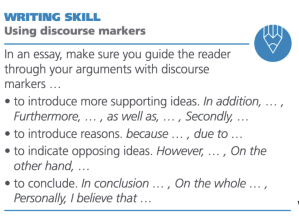
    We’ve mostly focused on verbal instructions so far. However, the visual component is clearly as important.  This is especially important in light of a common issue in many textbooks these days. For editing reasons (I assume?), a number of tasks are visually condensed in one “bullet point” or “activity” and this can create problems. Take a look at ex. 4 here (source: NGL Voices Upper Intermediate).

    Instructions to this activity can be quite overwhelming since, despite being presented as a single task, it’s actually a number of tasks in one. If you try to give the instructions and treat them as one task only, you can rest assured your students will experience in first person the effect of cognitive overload.

    The Writing Skill box referenced in activity 4.


    How can we make this easier for learners and less stressful for us? Let’s take it one step at a time – no pun intended (maybe). 

    First, we can use the question framework above to divide it into steps. The main question here is the “what?” – basically, the learning goals. How many goals does this activity have? If there is more than one learning goal, then this “activity” is actually more than one task condensed into one. So, if we look at 4 we have:

    1. Read (and understand) the Writing skill box.
    2. Find all the discourse markers in the essay [not shown here]
    3. Match each discourse marker with one of the categories in the box.

    Since the three learning goals are undoubtedly related (the idea is for learners to identify the target language), we can define these as “sub-goals” in the framework of activity 4. The issue here is that these three sub-goals are packed in one, visually crowded activity. This is a textbook example (I swear I don’t pun on purpose) of how poor visual design can lead to extraneous cognitive overload, making an otherwise straightforward activity quite cumbersome. 

    If you’re asking yourself – How do we fix this?, the great news is that we already have. The easiest and by far most efficient way to do it is to do exactly what we did above.
    Divide the main tasks in three subtasks, which I have named a, b, and c but you can call whatever you want. Then, use bullet points setting the three sub-aims / steps. In the case of 4, that would mean something along the lines of:

    4

    1. Read the writing skill box. (Check with a partner that you understand what discourse markers are).
    2. Underline all the discourse markers you can find in the essay.
    3. Match each of them with one of the categories in the Writing skills box. 

    You might have noticed that I’ve added an extra step in brackets in a: this is because I think that reading the box is not necessarily straightforward, and a minimal comprehension check could help. 

    These strategies are just two tips that can help us break down complex instructions. No matter how you do it, however, it’s the focus on minimal steps that really is crucial. Breaking instructions into smaller steps makes them less overwhelming and it helps students focus by giving them one clear step at a time. It also reduces the effort needed just to understand the task, which in turns leaves more mental space for actually doing the task. And when it comes to classroom management, it makes the lesson flow more smoothly and it makes it easier to monitor progress and spot problems. It helps learners manage their processing load, and ultimately makes progress more achievable by giving scaffolding and structure. And if it makes life that bit easier for us teachers, that’s all the better!

  • I don’t know about you, but I find that there are some grammar points that most course books seem to just not be able, for whatever reason, to address properly in their grammar banks at the back of the book. The list varies from textbook to textbook, but there are a few recurrent suspects, especially at higher levels. Among those, a particular bugbear of mine is passive voices. 

    When I teach grammar, I like to use the grammar bank at the end of the book as some sort of “key” to the guided discovery concept-checking questions (CCQs) that are commonly used to help students work out grammar rules. The way I do this is by having students discuss the CCQs in pairs for a few minutes, and then display screenshots from the appropriate grammar bank on the board and asking them to go to that page, read the grammar bank and use the content of the grammar bank to check their answers. This has the double effect of giving them a genuine reason to read, understand, and discuss the information in the grammar bank, and at the same time makes sure that they are presented with all the information the book gives on the topic – which is useful since some coursebooks, especially more recent ones, have a tendency to include in the grammar bank concepts and exceptions that are not present in the main section CCQs (but that’s a rant for another post!).  

    Usually, combining this procedure with careful monitoring and a quick Q/A plenary session is enough for them to have at least a general first grasp of the grammar. Where this becomes an issue, however, is when the grammar explanation is poor or ambiguous — and passive voices are a recurrent example of this. My opinion is that the reason why most passive voice explanations are unsatisfactory or ambiguous in these grammar banks is the fact that coursebooks writers often miss the point of what makes a passive a passive, probably because of the minimal linguistics training required to work in the field. I don’t blame them: a rational understanding of active and passive voices requires looking at grammar from a point of view that is a bit different from the usual parts-of-speech (nouns, verbs, etc.) / parts-of-a-sentence (subject, object, predicate etc.) approach. To understand passives, these two categories won’t be enough. We need to look at the sentence through a different lens, through the concept of thematic relations.

    Let’s do it inductively – exactly the way I do with my students.

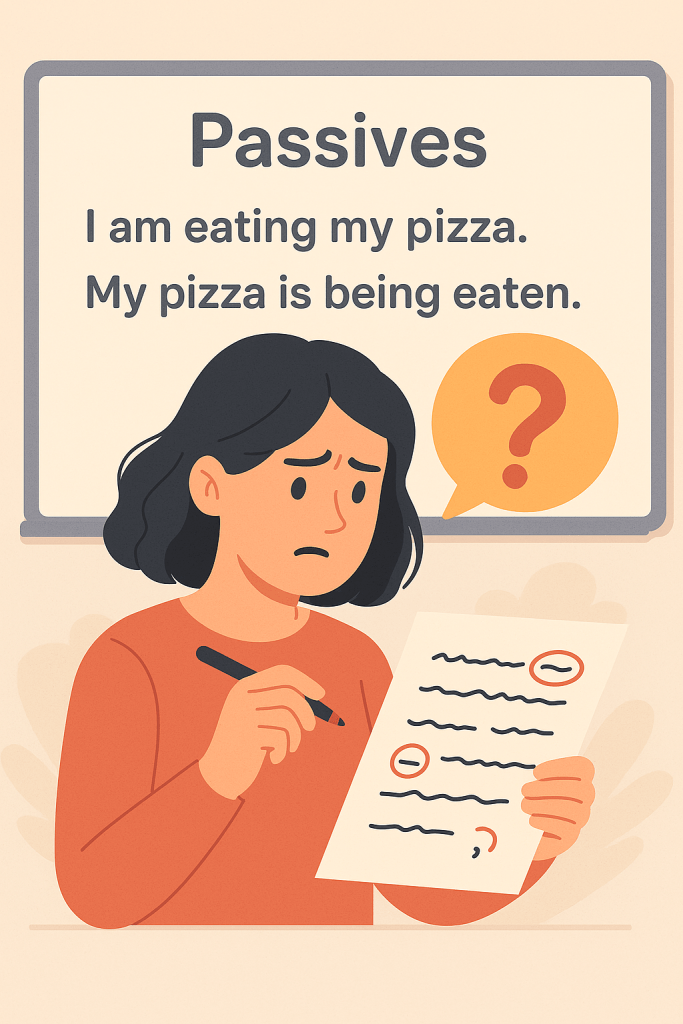
    Let’s take a basic example sentence in the active voice.

    a. I am eating my pizza.

    What’s the corresponding passive sentence? Even without knowing the necessary grammatical theory, most people will know that it’s:

    b. My pizza is being eaten.

    So far, so good. Now let’s do a bit of language analysis, looking at parts of a sentence. A rule I learned in primary school that still holds true when doing language analysis is: verb first! Let’s find and highlight in green the verb in both sentences.

    a. I am eating my pizza.
    b. My pizza is being eaten.

    Here is where things get tricky, and where we need to introduce a key difference, the one between subject (a part of a sentence) and agent (a thematic relation). Most of us will have probably been taught that the subject is the person or thing that “does the action” of the verb. However, this is only true in certain circumstances, and it’s actually not the definition of a subject. As a part of a sentence, the subject is the word or phrase that “dictates” verb agreement – i.e., it agrees with the verb tense and person. A quick test for this is taking the verb in isolation and saying “who or what” right before it. Don’t change the verb form – even if it sounds awkward. Let’s take (a) and (b) again:

    a. I am eating my pizza.

    Who or what am eating the pizza? → I am eating the pizza. I is the subject.

    b. My pizza is being eaten.

    Who or what is being eaten? → My pizza is being eaten. My pizza is the subject.

    Now that we’ve clarified what the subject and verb are in each sentence, it’s finally time to look at our third piece of the puzzle: the agent. And what is the definition of agent? You guessed it: the person or thing performing the action or event expressed by the verb. So, let’s look at our sentences again and identify the agent in both of them. Again, there’s a quick test for this, and it’s to say “Who or what is doing the action of (verb)?”

    a. I am eating my pizza.

    Who or what is doing the action of eating? → I is. I is the agent.

    b. My pizza is being eaten.

    Who or what is doing the action of eating? 

    And here is where my students usually get quite puzzled and start giving all the possible wrong answers, until someone finally comes up with an idea, which is simple but extremely well hidden: in (b), we don’t know who is doing the action of eating. In other words, the agent is unknown. Is there a way, however, we could add an agent to this sentence? Of course, most students will reply. We can use the preposition by. This will give us:

    c. My pizza is being eaten by me.

    So, if we look at these example sentences, considering subject, agent and verb, what is the difference between an active and a passive clause?

    a. I am eating my pizza.
    b. My pizza is being eaten.
    c. My pizza is being eaten by me.

    At this point, of course, the answer is quite straightforward. In an active sentence, the agent (I) and the subject (I) are the same. In a passive sentence, the subject (my pizza) and the agent (by me) are different. Not only that, but you can remove the agent altogether in a passive sentence, and indeed, that is exactly why we often choose to use the passive: to focus on the action rather than on who or what is performing it. 

    If you have a particularly strong group, you could add another thematic relation to the mix, that of patient: this is the person or thing that experiences or is affected by an action or event. In a passive sentence, the subject is the patient, i.e. it experiences or is affected by the action or event stated by the verb. However, I usually avoid introducing this concept, as it further complicates the explanation, and the truth is that learners don’t really need to know this. Once they understand the agent / subject difference, that is usually enough for them to distinguish between active and passive sentences, especially in real contexts.

    A good follow-up activity is taking some example sentences, or a short text, and asking students to identify all verbs, subjects and agents. Again, careful monitoring and clear plenary feedback are essential at this stage. Once learners familiarize themselves with this distinction in context, you can then move on to the classic controlled practice exercises that ask students to choose the active or passive form of the verb. Don’t push them too hard; grammar takes time to properly sediment. Remember to focus on understanding, not on the exercise.

    Hopefully, this approach can be useful to everyone in their daily teaching. While not common, it’s quite simple to explain and it gives a clear, binary distinction between active and passive voices that students can rely on when approaching passive-related activities, both in productive and receptive skills. There is more to be said on passives, especially in relation to direct, indirect objects and double-object verbs, but as I always tell my students: lads, we’re good, enough grammar for today. 

  • We all know how important it is to display clear aims and goals at the beginning of our classes. In addition to this, as suggested by David Byrne and Mark Heffernan in their introduction to their new MET column “On Reflection”, and following the approach adopted by the school I work for, I always try to relate these goals to students’ personal lives, including when teaching writing. The way I do this is by asking simple questions, such as: Have you ever written this type of text? When? When and why do people write these types of texts? In which settings? How can this type of text be useful to you?

    Cue one of the most common writing tasks for Intermediate level students: the informal email to a friend. As most readers will know, the target texts for Intermediate writing classes tend to vary across a range of different types: short essays, reviews, and of course emails. And here’s where things get sticky. Every time I have to teach this oh-so-loved topic, I’m always internally rolling my eyes knowing I have to try and spin it in a way that makes it somehow relatable to students. And at times, students will ask back when did I last write an email to a friend, leading me to candidly state that yeah, no, I don’t remember. 

    And it’s not just me. I’m sure most readers will relate to this feeling to some extent. In my school, the moaning consensus in the staff room is that teaching informal emails to friends is at best a mere exercise. And with good reason: I’m ready to bet that most of us won’t have written an email to know how friends have been, to ask for advice, or to know about their weekend plans for at least 10 years. 2007 it’s long gone (unfortunately!).

    Of course, it’s not like we don’t write informal emails in English anymore. We actually do all the time – we just don’t write them to our friends. Most of us will write and receive informal emails in professional settings or when dealing with companies, providers, and so on. Let’s face it: in this day and age, most of us will use some form of instant messaging or arrange a video call regardless of how far the person lives or when the last time we talked was. Why, then, do syllabi keep teaching ways to write informal emails to friends?

    Why emails?

    Email and letter writing is a skill that has long been at the core of communicative language teaching. There are a good few reasons for this: we want to provide students with relevant, real-life language skills that they can use to produce real texts in real-life contexts. Email writing ticks all of these boxes: we often write emails in real life in a variety of different contexts, and there are a number of specific linguistic and pragmatic skills that are involved in email writing. In particular, informal emails tend to have a specific type of register due to what Baron (2000) calls the speech/writing line, which he claims is much thinner than in more formal types of writing. Informal emails also aim to teach other important pragmatic competence points, such as recognising and adapting a casual register, using contractions and engaging in a conversational tone in writing. All of these skills are still extremely valuable for students. In particular, readers will surely know that recognizing and being able to adopt the correct register and tone to a situation is one of the most complex skills for students to master.

    Plus, informal emails are inherently easy to integrate in a classroom and inherently teachable. They’re a self-contained text of medium length which can be easily modeled and adapted to various contexts, making teaching and assessment for content, structure, coherence, cohesion, and language quite straightforward. I haven’t found any research so far, but my impression is that it’s hard to think of a similar task where we can assess learners’ pragmatic competence and informal writing skills in the context of talking to a friend.

    The type of text that has replaced informal emails, instant messaging, would require us to step away from the way writing is commonly taught, which would in turn be much trickier to implement in an exam context. Informal emails aim to teach very similar types of writing skills, language and pragmatic competences without forcing us to adopt new or unorthodox approaches. 

    However, even in the light of these reasons, the point raised by my students’ question still stands. Informal emails to friends are just not relevant anymore. They’re not something most people can relate to, or a type of text that they use. By still teaching them and presenting them as relevant, we are doing students a disservice. 

    A task that is not relevant will be viewed by students as an “exercise” for the sake of the exercise, which goes against the idea of authenticity and removes communicative purpose. Ultimately, it’s a missed learning opportunity. 

    What can we do?

    The way I see it, there are two main directions of travel here: one is working on the text, the other one is working on the context.  

    The first approach consists of introducing alternative writing tasks based on more relevant types of text, such as instant messaging and texting. As I’ve previously mentioned, this involves a number of challenges, and it is definitely more time-consuming for busy language teachers. Some books do have writing classes on the language of texting (one of my favourites is this lesson from NGL life Intermediate), but the setting is still quite artificial and struggles to reproduce the actual dynamics of texting or instant messaging, such as short messages and quick replies. I am currently working on developing a writing class on this topic so watch this space

    A quicker fix to this problem is following the second approach, which is adapting the context of pre-existing writing materials on informal email writing so that it matches students’ real-life experiences. As we previously discussed, arguably, the most common setting for informal email writing today are work emails with colleagues or external companies.  

    Let’s take as an example this writing task from the latest edition of a popular NGL coursebook:

    Instead of writing to an old friend asking how they are, give the option to change the topic and make it about writing to a colleague working in another branch or department (for example), writing to a professor or teacher from a previous course or class, or writing to someone we know from a company we have dealt with in the past (e.g. our accountant, our property manager etc.). This type of setting will be much more relevant while still assessing very similar skills and competences, including functional language. 

    Two things are important to notice here: first, there is a reason why I said “give the option to”. Despite the fact that most people don’t, it’s hard to make blanket statements on whether students actually write informal emails. In addition, some students might still want to practice informal email writing to a friend since this is an extremely common exam task. Giving them the option to do so takes little away from relevant practice, and having them autonomously choose this type of task puts them front and centre of their learning rather than pushing an artificial narrative where informal emails to friends are a-critically presented as a given. 

    Secondly, many of these classes include some type of grammar or functional language point. When changing the context, it’s important to make sure these language points are still included in the task and assessment. For example, in our task above, the lesson plan included teaching phrases to refer to previous conversations, such as “the last time we spoke”. When preparing an alternative task, make sure to design it in a way that the language aims are as close as possible to the original task. For example:

    Write an informal email to a colleague from another department. They emailed you a few weeks back, but you’ve been busy and couldn’t respond. Think about:

    • Why you couldn’t respond to their email. 
    • The situation you were both in last time you talked, and their request to you.
    • Your situation with work at the moment.
    • Questions you want to ask your colleague.

    This is an example of how the task can be adapted to a more relevant setting while still teaching and assessing the same language points as the original task. Additionally, presenting different options for informal emails can be a springboard for active reflection. In some cultures, work emails are quite formal and it might be unusual to send informal emails to colleagues or professors. These tasks can be used to make students reflect on the fact that in English people tend to use an informal tone to appear friendly, even when talking to colleagues or managers (depending on the situation, of course)!  Highlight how it’s important to keep a fairly formal tone when unsure, but avoid sounding too formal which can be awkward.

    These are, of course, only some of the ways these tasks can be adapted. Most teachers will have their own way of approaching this, and there is no one better suited to make (informed!) decisions for your own classes than you!

    To wrap up, informal emails are not dead, but the context in which they are written is very different from the way many coursebooks and exams still present them. New types of tasks involving instant messaging and social media will certainly emerge and I am currently working on one myself, which I will present in a future article. In the meantime, however, considering alternative contexts that mirror how we actually interact today can do the trick – and make informal emails relevant again.

  • Any TEFL teacher with some experience teaching higher levels will be familiar with this scene. You are teaching a classic reading-guided discovery-practice class, and the lesson is going according to plan. The target grammar for today is a thorny topic: reported speech. When it is time to check students’ comprehension of the guided discovery elicitation questions, puzzled and perplexed expressions start appearing on their faces. Questions are being asked, one after the other, and the class is derailed by trying to explain the grammar point. This has happened to me several times, prompting me to wonder why certain grammatical structures are so difficult for students to grasp. Ellis (2008) highlights how, among other factors, L1 interference and complexity of the target grammar likely play a role in students’ understanding of the grammar point itself. As a bilingual speaker of English and Italian, I started reviewing the language analysis and the teaching materials on reported speech, looking for notable differences from my first language that might make it difficult for speakers of Romance languages to understand. That is when I finally noticed something: when explaining reported speech, the word ‘that’ is often omitted. This would never happen in reported speech in Italian or Spanish.

    To understand better why this happens and why this is relevant, we need to look at what role the word “that” plays in these contexts.

    In English, the word “that” has a number of different uses. One of these is what is called a declarative complementizer, which has the role of turning what follows into a complement. For example:

    (a) He told me that he sold his watch.

    In the sentence above, “he sold his watch” is effectively the object (complement) of the verb “told”. Compare this to the sentence:

    (b) He told me a lie.  

    The role of “he sold his watch” in (a) is effectively the same as the role that “a lie” has in (b), which is the object. The word that, in this case, serves the function of declarative complementizer, i.e. it indicates that the embedded clause “he sold his watch” has the function of object. However, as you might already have noticed, if you look at (a), while correct, it’s not what most speakers of English would say as their first choice. Most likely, if you were to actually use (a) in your everyday life, you’d probably say something like:

    (c) He told me he sold his watch.

    This phenomenon is what we call declarative complementizer omission, and it is by no means limited to reported speech. Indeed, it can happen across a range of different grammatical structures and patterns which will be quite familiar to teachers working with higher level learners. To name a few:

    • Patterns of the verb wish: I wish [that] you wouldn’t do that.
    • Cognitive and perception verb patterns: I think [that] she is right.
    • Clauses where “it” is the subject, often expressing degrees of likelihood: it’s unlikely [that] he did that.
    • Other verb patterns, e.g. with the verb “recommend”: They recommend [that] we do this.

    Example sentences like the above are common in grammatical explanations of these structures, and the omitted “that” is often not mentioned at all. The reason for this is quite straightforward: general English TEFL textbooks rightfully aim to teach natural language, and they often focus on meaningful chunks of language rather than on more abstract grammatical examples. In addition, writers of textbooks are mostly L1 users of English, and to an English-speaking brain the presence of the declarative complementizer is an optional rather than a necessity in these cases.

    Why is this relevant to students’ understanding of these grammatical forms? Well, as I hinted to previously, this phenomenon, while not a rare occurrence in languages across the world, is far from universal. Indeed, in many languages with large pools of learners of English, such as Italian, French, Spanish, or Japanese, declarative complementizer omission is either impossible or much more limited than it is in English. Take the following sentences from Italian, Spanish, and Japanese which are direct translations of (c) (“He told me he sold his watch.”):

    (i) Mi ha detto che ha venduto il suo orologio.

    (s) Me dijo que vendió su reloj.

    (j) Kare no tokei utta to itta.

    In all three cases, the declarative complementizer “che” / “que” / “to” cannot be omitted or the sentence would not be grammatical. This is a major difference that is more than likely to create issues in understanding and using target grammar presenting this phenomenon. As a bilingual speaker of Italian and English myself, I can see how, especially at the production stage, justapoxing the two verb phrases “he told me” and “he sold” can lead to misunderstandings and add another layer of complexity to an already complex grammatical structure such as reported speech.

    The way to approach this problem is as straightforward as it might seem: explicitly highlight the missing “that” when teaching these structures. Depending on your preferences, you can do this in a few ways. Let’s take the following sentence as an example:

    (d) He told me he couldn’t make it.

    1. Create a CCQ (Concept Checking Question) to elicit the missing “that”, e.g. what word is being omitted between “me” and “he”?
    2. Show the phrase on the board with a missing gap in brackets, e.g.  He told me (________) he couldn’t make it.
    3. Simply present the sentence by adding the missing word in brackets, e.g. He told me [that] he couldn’t make it.

    Make sure to put “that” in brackets so that there is no confusion over the fact that it’s optional. Grammatically, there is no need to go into too much detail on the role of this “that”, as this will probably only confuse students further. It might be interesting, however, to highlight and have the students reflect on what pragmatic difference there is between using and not using the declarative complementizer: adding that makes the sentence more formal, clearer and deliberate, whereas its omission is more common in colloquial speech. 

    It goes without saying that the same exact approach can be used to address complementizer omission in any of the structures where this appears. However, it is also crucial to point out that there are a number of instances where the declarative complementizer cannot be omitted:

    • after a number of verbs like reply and shout and, in general, so-called manner‐of‐speaking verbs (whisper, murmur, mutter, grumble, scream, etc.):

    (e) She replied that she had already done it. 

    (f) He shouted that he was tired.

    • Immediately after nouns: 

    (g) I am of the opinion that it would be a terrible idea. 

    I haven’t had the chance to carry out more formal research on the impact of these strategies yet. However, anecdotal evidence from the classrooms and from colleagues who, after this discussion, started highlighting declarative complementizer omission to students points to a better understanding and use of the target language by learners when this phenomenon is pointed out explicitly. This would also resonate with the fact that choosing to use the declarative complementizer in these sentences makes them clearer. This is because it clearly delineates the boundary between the matrix clause and the “object” (embedded) content, improving clarity. 

    If you have been that teacher in that class where students’ puzzled faces were staring at you in eternal perplexion, this is one more trick up your sleeve that will hopefully improve your lesson plan and delivery. As to preventing unexpected and borderline philosophical students’ questions on grammar, there is nothing this writer or anyone else can do I’m afraid!