

I don’t know about you, but I find that there are some grammar points that most course books seem to just not be able, for whatever reason, to address properly in their grammar banks at the back of the book. The list varies from textbook to textbook, but there are a few recurrent suspects, especially at higher levels. Among those, a particular bugbear of mine is passive voices.
When I teach grammar, I like to use the grammar bank at the end of the book as some sort of “key” to the guided discovery concept-checking questions (CCQs) that are commonly used to help students work out grammar rules. The way I do this is by having students discuss the CCQs in pairs for a few minutes, and then display screenshots from the appropriate grammar bank on the board and asking them to go to that page, read the grammar bank and use the content of the grammar bank to check their answers. This has the double effect of giving them a genuine reason to read, understand, and discuss the information in the grammar bank, and at the same time makes sure that they are presented with all the information the book gives on the topic – which is useful since some coursebooks, especially more recent ones, have a tendency to include in the grammar bank concepts and exceptions that are not present in the main section CCQs (but that’s a rant for another post!).
Usually, combining this procedure with careful monitoring and a quick Q/A plenary session is enough for them to have at least a general first grasp of the grammar. Where this becomes an issue, however, is when the grammar explanation is poor or ambiguous — and passive voices are a recurrent example of this. My opinion is that the reason why most passive voice explanations are unsatisfactory or ambiguous in these grammar banks is the fact that coursebooks writers often miss the point of what makes a passive a passive, probably because of the minimal linguistics training required to work in the field. I don’t blame them: a rational understanding of active and passive voices requires looking at grammar from a point of view that is a bit different from the usual parts-of-speech (nouns, verbs, etc.) / parts-of-a-sentence (subject, object, predicate etc.) approach. To understand passives, these two categories won’t be enough. We need to look at the sentence through a different lens, through the concept of thematic relations.
Let’s do it inductively – exactly the way I do with my students.
Let’s take a basic example sentence in the active voice.
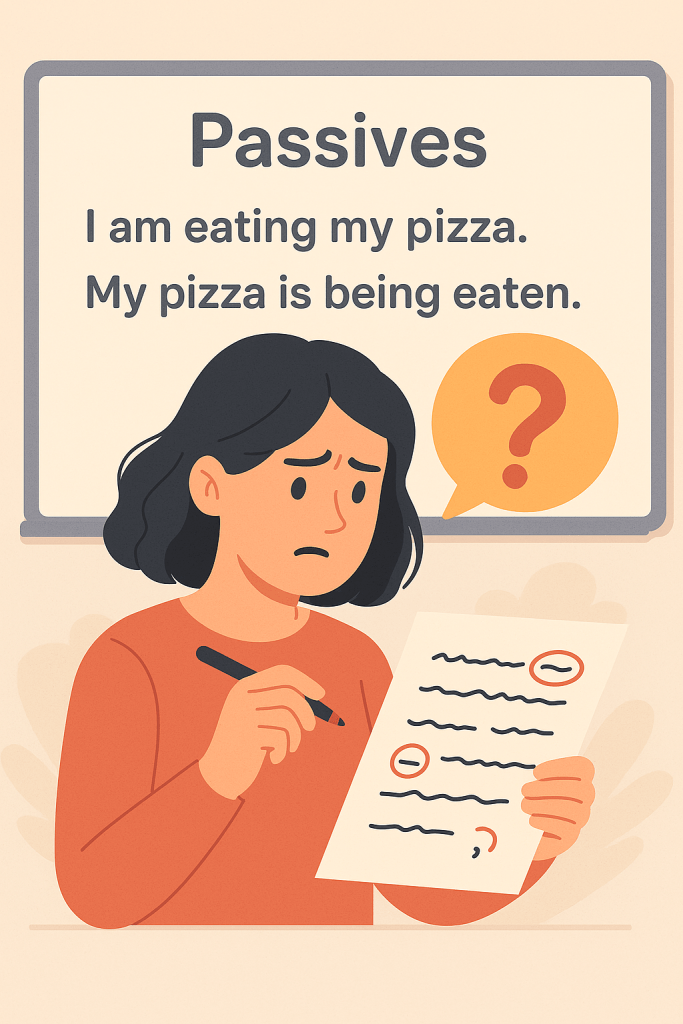
a. I am eating my pizza.
What’s the corresponding passive sentence? Even without knowing the necessary grammatical theory, most people will know that it’s:
b. My pizza is being eaten.
So far, so good. Now let’s do a bit of language analysis, looking at parts of a sentence. A rule I learned in primary school that still holds true when doing language analysis is: verb first! Let’s find and highlight in green the verb in both sentences.
a. I am eating my pizza.
b. My pizza is being eaten.
Here is where things get tricky, and where we need to introduce a key difference, the one between subject (a part of a sentence) and agent (a thematic relation). Most of us will have probably been taught that the subject is the person or thing that “does the action” of the verb. However, this is only true in certain circumstances, and it’s actually not the definition of a subject. As a part of a sentence, the subject is the word or phrase that “dictates” verb agreement – i.e., it agrees with the verb tense and person. A quick test for this is taking the verb in isolation and saying “who or what” right before it. Don’t change the verb form – even if it sounds awkward. Let’s take (a) and (b) again:
a. I am eating my pizza.
Who or what am eating the pizza? → I am eating the pizza. I is the subject.
b. My pizza is being eaten.
Who or what is being eaten? → My pizza is being eaten. My pizza is the subject.
Now that we’ve clarified what the subject and verb are in each sentence, it’s finally time to look at our third piece of the puzzle: the agent. And what is the definition of agent? You guessed it: the person or thing performing the action or event expressed by the verb. So, let’s look at our sentences again and identify the agent in both of them. Again, there’s a quick test for this, and it’s to say “Who or what is doing the action of (verb)?”
a. I am eating my pizza.
Who or what is doing the action of eating? → I is. I is the agent.
b. My pizza is being eaten.
Who or what is doing the action of eating?
And here is where my students usually get quite puzzled and start giving all the possible wrong answers, until someone finally comes up with an idea, which is simple but extremely well hidden: in (b), we don’t know who is doing the action of eating. In other words, the agent is unknown. Is there a way, however, we could add an agent to this sentence? Of course, most students will reply. We can use the preposition by. This will give us:
c. My pizza is being eaten by me.
So, if we look at these example sentences, considering subject, agent and verb, what is the difference between an active and a passive clause?
a. I am eating my pizza.
b. My pizza is being eaten.
c. My pizza is being eaten by me.
At this point, of course, the answer is quite straightforward. In an active sentence, the agent (I) and the subject (I) are the same. In a passive sentence, the subject (my pizza) and the agent (by me) are different. Not only that, but you can remove the agent altogether in a passive sentence, and indeed, that is exactly why we often choose to use the passive: to focus on the action rather than on who or what is performing it.
If you have a particularly strong group, you could add another thematic relation to the mix, that of patient: this is the person or thing that experiences or is affected by an action or event. In a passive sentence, the subject is the patient, i.e. it experiences or is affected by the action or event stated by the verb. However, I usually avoid introducing this concept, as it further complicates the explanation, and the truth is that learners don’t really need to know this. Once they understand the agent / subject difference, that is usually enough for them to distinguish between active and passive sentences, especially in real contexts.
A good follow-up activity is taking some example sentences, or a short text, and asking students to identify all verbs, subjects and agents. Again, careful monitoring and clear plenary feedback are essential at this stage. Once learners familiarize themselves with this distinction in context, you can then move on to the classic controlled practice exercises that ask students to choose the active or passive form of the verb. Don’t push them too hard; grammar takes time to properly sediment. Remember to focus on understanding, not on the exercise.
Hopefully, this approach can be useful to everyone in their daily teaching. While not common, it’s quite simple to explain and it gives a clear, binary distinction between active and passive voices that students can rely on when approaching passive-related activities, both in productive and receptive skills. There is more to be said on passives, especially in relation to direct, indirect objects and double-object verbs, but as I always tell my students: lads, we’re good, enough grammar for today.
 The Teaching Tapestry TEFL
Leave a comment